
By Josh Saxton, Osteopath and Accredited Exercise Physiologist
Your bathroom scales have a blind spot. They can tell you that you are getting lighter, but they cannot tell you whether you are getting stronger.
For people using prescribed weight-loss medication, that distinction matters. An Australian trial published in Nature Medicine found that adding resistance training to tirzepatide treatment reduced lean tissue loss and improved strength. Weight and fat loss were similar between groups (3).
My take? I do not mind where you start. I want strength in the plan while the weight is coming off.
What did the researchers test?
Professor Daniel J. Green and colleagues followed 120 initially inactive adults with overweight or obesity for 40 weeks. Participants were aged approximately 50 to 70. There were equal numbers of men and women, and all the women were postmenopausal (3).
Everyone received tirzepatide, a prescription medicine marketed as Mounjaro that acts on GIP and GLP-1 receptors (4). Researchers randomly allocated participants to continue their usual activities or add three supervised resistance training sessions each week (3).
That comparison matters: this trial tested adding a training program during medication treatment. It did not compare exercise with medication.
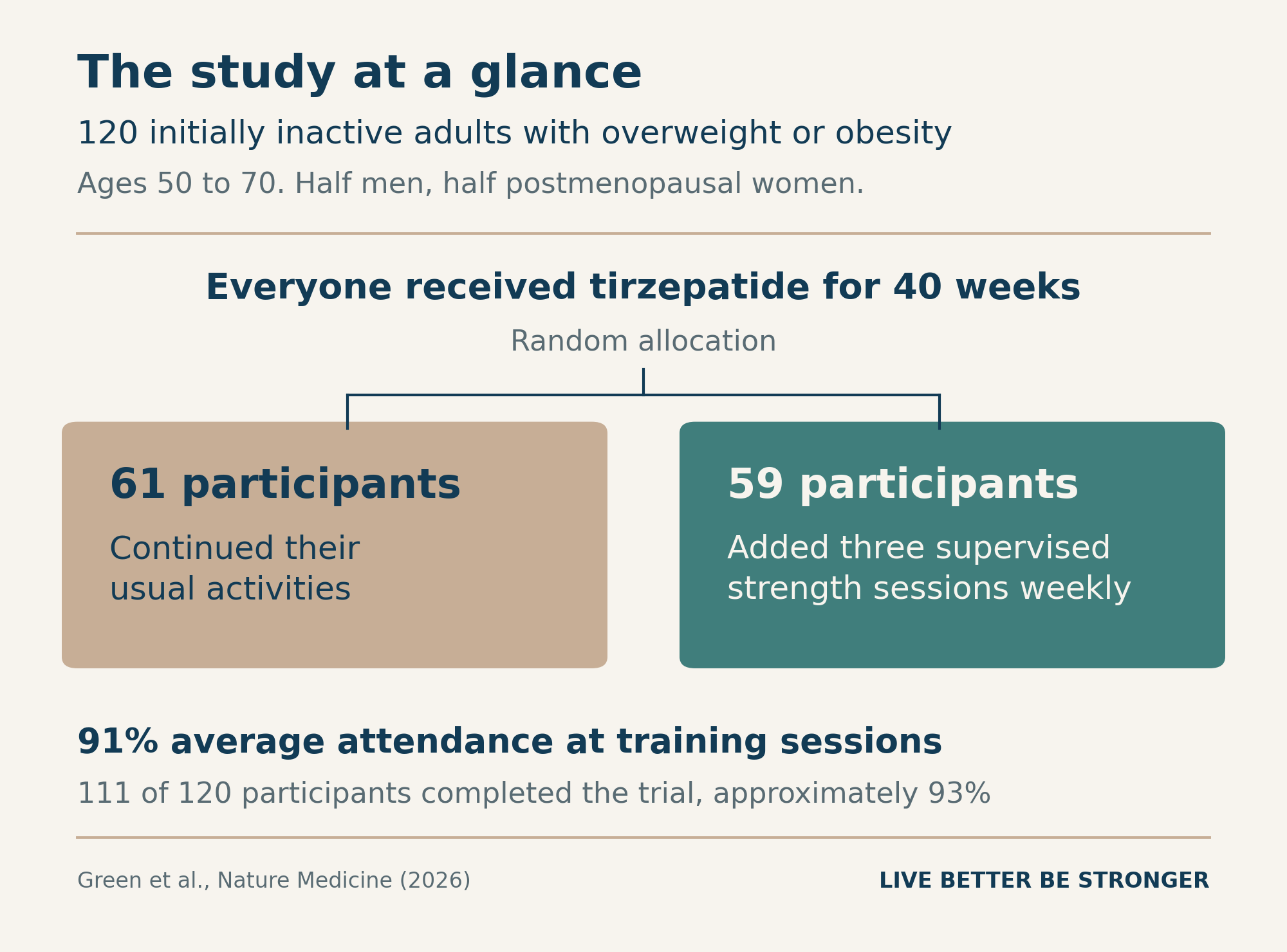
Study overview. All participants received tirzepatide. The exercise group received supervised, progressive resistance training (3).
Similar weight loss, different strength results
Both groups lost about 22 kg, including roughly 17-18 kg of fat. Training did not produce significantly greater fat loss in this trial (3).
Strength told a different story. The training group improved on all three strength tests. The usual-activity group became weaker on those tests (3).
Bench press strength increased by 4.68 kg with training and decreased by 4.09 kg with usual activities. Lat pulldown and knee extension results followed the same pattern (3). These numbers describe changes in the load participants could lift, not kilos of muscle gained or lost.
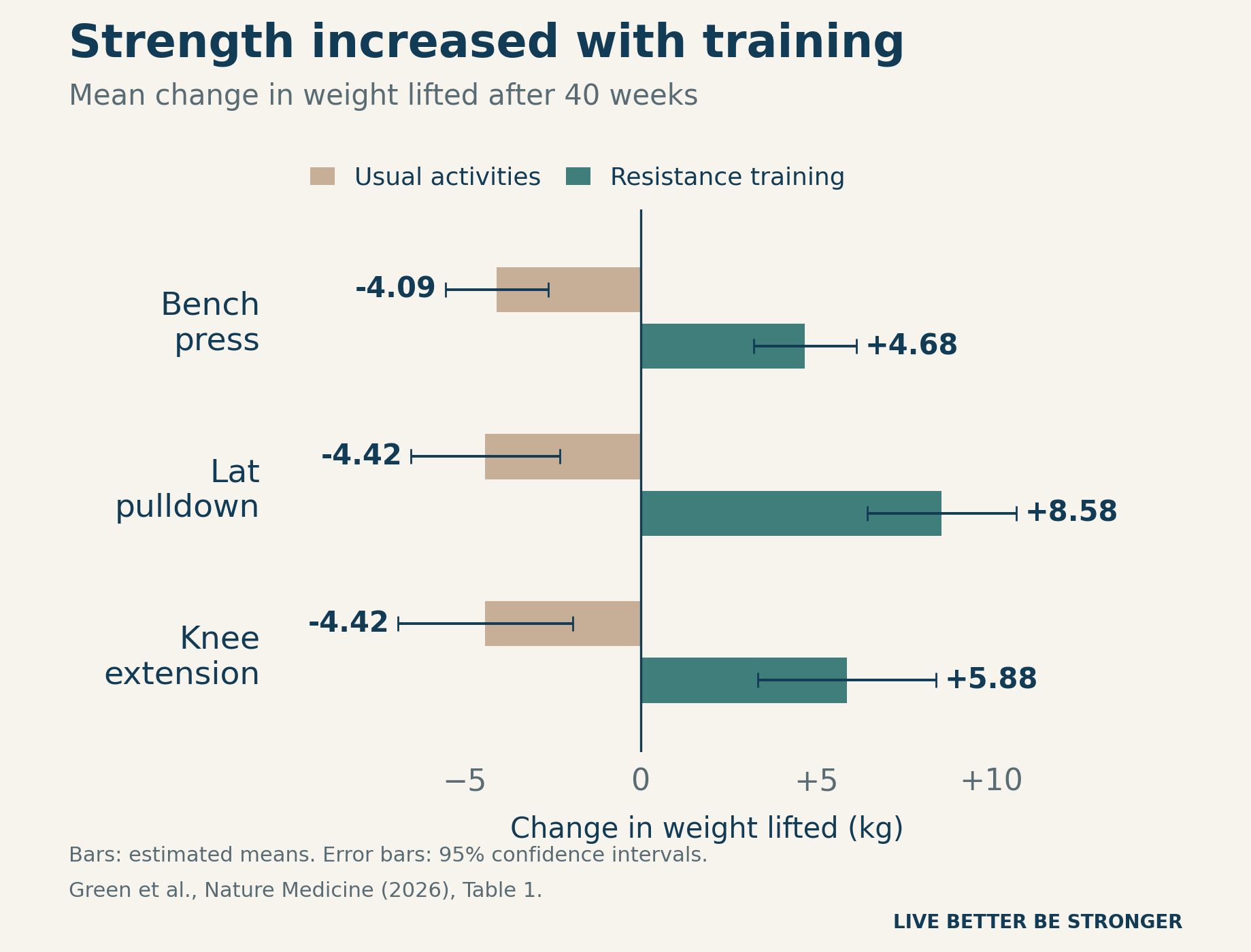
Strength results over 40 weeks. Bars show model-estimated mean changes in the load lifted. Error bars show 95% confidence intervals, not the range of individual results—source: Table 1 in reference 3.
What does 24% less lean tissue loss mean?
The training group lost 3.57 kg of lean soft tissue, compared with 4.67 kg in the usual-activity group. That is roughly 1.1 kg less loss, or approximately 24% less lean tissue loss (3).
Training reduced the loss. It did not prevent it completely.
The researchers used DXA scans. Lean soft tissue includes muscle, water and other non-fat soft tissues, and this outcome excludes bone mineral (3). We should therefore avoid describing all the lost lean tissue as lost muscle.
People became stronger despite losing some lean tissue (3). Muscle size and strength are related, but they are not interchangeable.
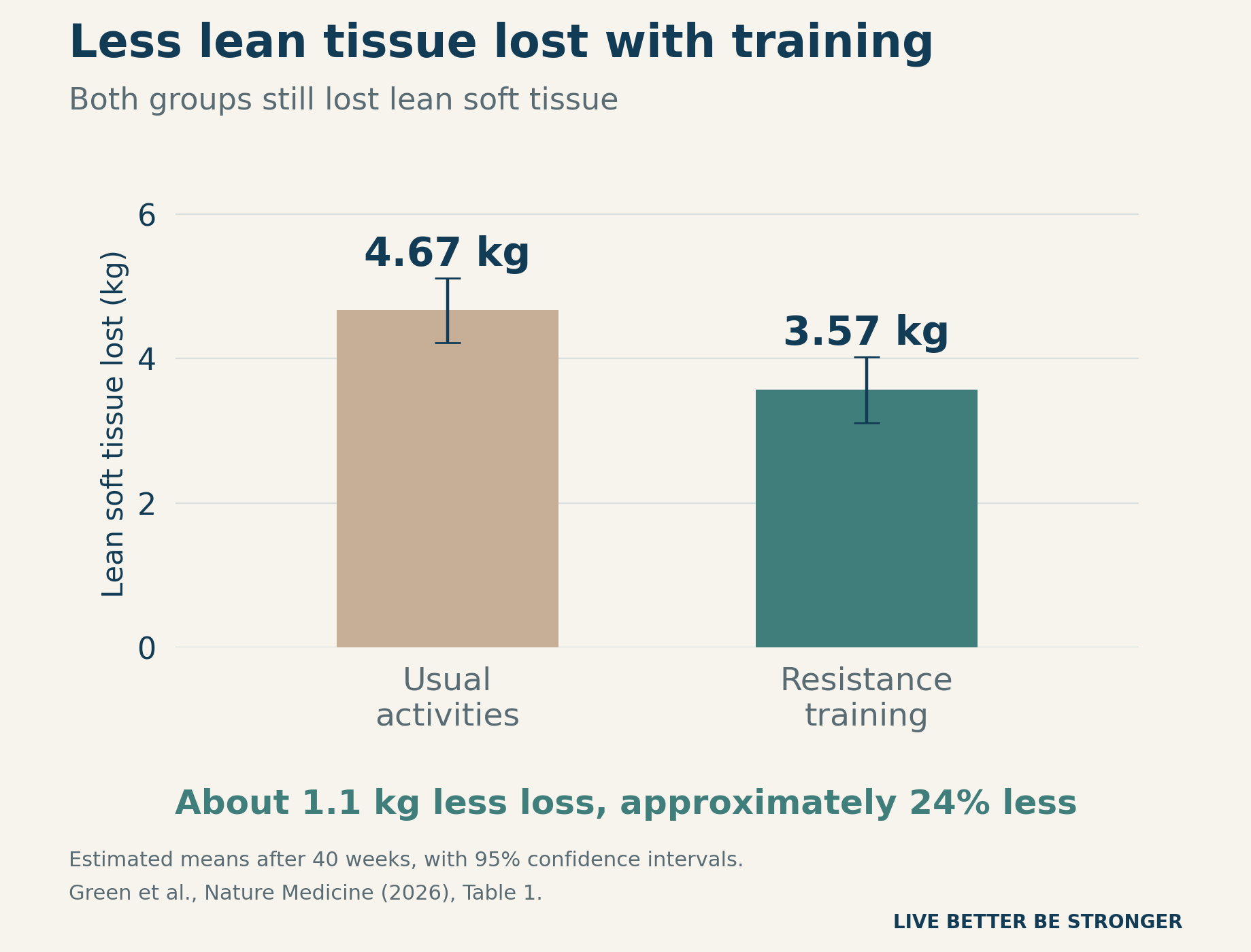
Lean soft tissue loss over 40 weeks. Both groups lost lean tissue. Values are model-estimated means with 95% confidence intervals—source: Table 1 in reference 3.
This was a progressive training program.
Participants attended three supervised, hour-long group sessions each week with Accredited Exercise Physiologists. They started with lighter exercises and technique development, then progressed towards more demanding strength and muscle-building work (3).
Average training attendance was 91%. Of the 120 participants who entered the trial, 111 completed it (approximately 93%) (3).
Random allocation, high completion, and repeated measurements of body composition and strength make this evidence useful. It gives us more information than weight measurements alone.
What are the limitations?
The findings deserve attention, alongside some clear limits (3):
A selected population. Participants were initially inactive, aged 50 to 70, and without diabetes or established cardiovascular disease. All women were postmenopausal. The exact effects in other populations remain uncertain.
One medication and one centre. These numbers do not automatically apply to semaglutide, other medicines or different settings.
Substantial support. Three supervised sessions weekly and high attendance may be difficult to reproduce in everyday life.
Forty weeks of follow-up. The trial does not establish outcomes years later, after stopping medication, or for falls and independence.
Measurement and comparison limits. DXA does not directly measure muscle volume. Strength assessors were not blinded. Nutrition was not prescribed, and there was no medication-free group or alternative exercise program.
Eli Lilly supplied the medication, and some investigators disclosed industry relationships. The authors reported investigator-led trial conduct and analysis (3). Those disclosures provide relevant context, not evidence that the findings are invalid.
What does this change in practice?
It strengthens the case for making resistance training part of the treatment plan while weight is coming off. The aim includes maintaining what your body can do, alongside reducing what it weighs (2,3).
Both groups improved blood pressure, blood glucose and several blood fat measures. Training added strength benefits and reduced lean tissue loss, without significantly greater improvements in those health markers (3).
For someone starting medication, I would translate this into four steps:
Establish a starting point. Assess current activity, strength, health conditions and any pain or movement limitations.
Build a manageable strength routine. Choose exercises for the main muscle groups, learn the movements and gradually increase the challenge. Equipment and supervision should suit the person.
Track more than weight. Record repetitions, resistance and how everyday tasks feel. Review progress and adjust the program.
Coordinate the plan. Discuss medication concerns with the prescriber and nutrition needs with an appropriately qualified practitioner. This trial did not test a prescribed nutrition intervention (3).
You do not need to overhaul everything on day one. Start with something achievable and build during treatment.
Common questions
Is this relevant if I take Wegovy or Ozempic?
Yes, the broader message is relevant. Research on resistance training during dietary weight loss already supports benefits for strength and retaining fat-free mass (2). This tirzepatide trial adds direct evidence during medication-assisted weight loss (3).
Together, that supports including resistance training for people losing weight with medicines such as semaglutide. This is a reasonable clinical inference, not proof of identical results with every medicine. The exact benefit, including whether the same 24% reduction in lean tissue loss occurs, needs testing.
Do I need three supervised gym sessions every week?
Three sessions were the program tested, not a minimum everyone must meet to benefit (3). Australian guidance recommends moderate-to-vigorous activity for at least 30 minutes on most days, plus muscle-strengthening activity on at least two days each week (1).
For a practical weekly target, 30 minutes on five days adds up to 150 minutes, alongside strength work on at least two days. Build towards this from your starting point. General activity targets do not guarantee the same results as the trial's supervised program.
Can I become stronger while losing weight?
Yes. The training group improved on all three strength tests despite losing some lean tissue (3). That is why reviewing strength alongside body weight gives us a more useful picture of progress.
Start where you are and get stronger from there.
As an Osteopath and Accredited Exercise Physiologist, I help people develop an exercise plan they can use independently, with reviews and progression when needed.
At Live Better Be Stronger in Norwood, Adelaide, that starts with your health, current capacity and what you want to do. Explore our exercise physiology and rehabilitation approach, or book an appointment with Josh at Bounce Back Osteopathy, 162 Magill Road, Norwood.
References
1. Australian Government Department of Health, Disability and Ageing. Recommendations for adults aged 18 to 64 years. 2026. Available at: https://www.health.gov.au/topics/physical-activity/24-hour-movement-guidelines-for-all-australians/recommendations-for-adults-18-to-64-years. Accessed November 16, 2026.
2. Binmahfoz A, Dighriri A, Gray C, Gray SR. Effect of resistance exercise on body composition, muscle strength and cardiometabolic health during dietary weight loss in people living with overweight or obesity: a systematic review and meta-analysis. BMJ Open Sport Exerc Med 11: e002363, 2025. doi:10.1136/bmjsem-2024-002363.
3. Green DJ, Haynes A, Underwood DR, et al. Resistance exercise to attenuate lean mass loss during tirzepatide therapy for obesity: a randomized controlled trial. Nat Med, 2026. Published online November 9, 2026. doi:10.1038/s41591-026-04752-5.
4. Therapeutic Goods Administration. Mounjaro. Australian Prescription Medicine Decision Summary. 2023. Available at: https://www.tga.gov.au/resources/auspmd/mounjaro. Accessed November 16, 2026.
